Concrete Estimating Software for Concrete Contractors
Concrete bids turn on cubic yards, forms and finish, and there’s no room for a short load on pour day. Trades HQ turns your measurements into yards and estimate lines you can trust.
Volume has to be right. A short load on pour day costs time and money.
Forms, base and reinforcement. Gravel base, forms, rebar or mesh are their own lines.
Finish and extras. Broom, stamped or exposed finishes, plus sealer and saw cuts, change labor.
Site conditions. Access for the truck, pumping and haul-away can change the job.
How Trades HQ helps concrete contractors
Ready-made concrete template. Start from a slab template with ready-mix, wire mesh, rebar and labor lines.
Quick Measure for concrete. Enter sizes for slabs, walls or footings, and it turns them into estimate lines.
Measure from blueprints. Measure slab and footing areas right off a blueprint PDF.
Labor-rate guidance by state. See typical cement mason wages in your state, then set your own rate.
Material price requests. Send one price request to your suppliers and turn the best quote into a purchase order.
Live job profit as labor and materials come in.
A concrete slab estimate, step by step
Measure length, width and thickness.
Convert to cubic yards: length × width × thickness (in feet) ÷ 27.
Add extra for uneven grade and spillage; many contractors add about 5–10%.
Add base, forms, reinforcement and finishing.
Add pump, saw cuts, sealer and haul-away if needed.
Apply your overhead and profit.
Example (illustrative): a 20 × 20 ft slab, 4 inches thick.
Step
Math
Result
Thickness in feet
4 ÷ 12
0.333 ft
Volume
20 × 20 × 0.333
133.3 cu ft
Cubic yards
133.3 ÷ 27
4.94 cu yd
Plus about 10%
4.94 × 1.10
about 5.4 cu yd
Pricing tip: Order a little extra. A short load on pour day costs more than leftover concrete. And remember that markup and margin aren't the same number: a 20% margin needs a 25% markup. The Estimating Basics guide walks through the math, and the free markup and margin calculator does it for you.
See it in Trades HQ
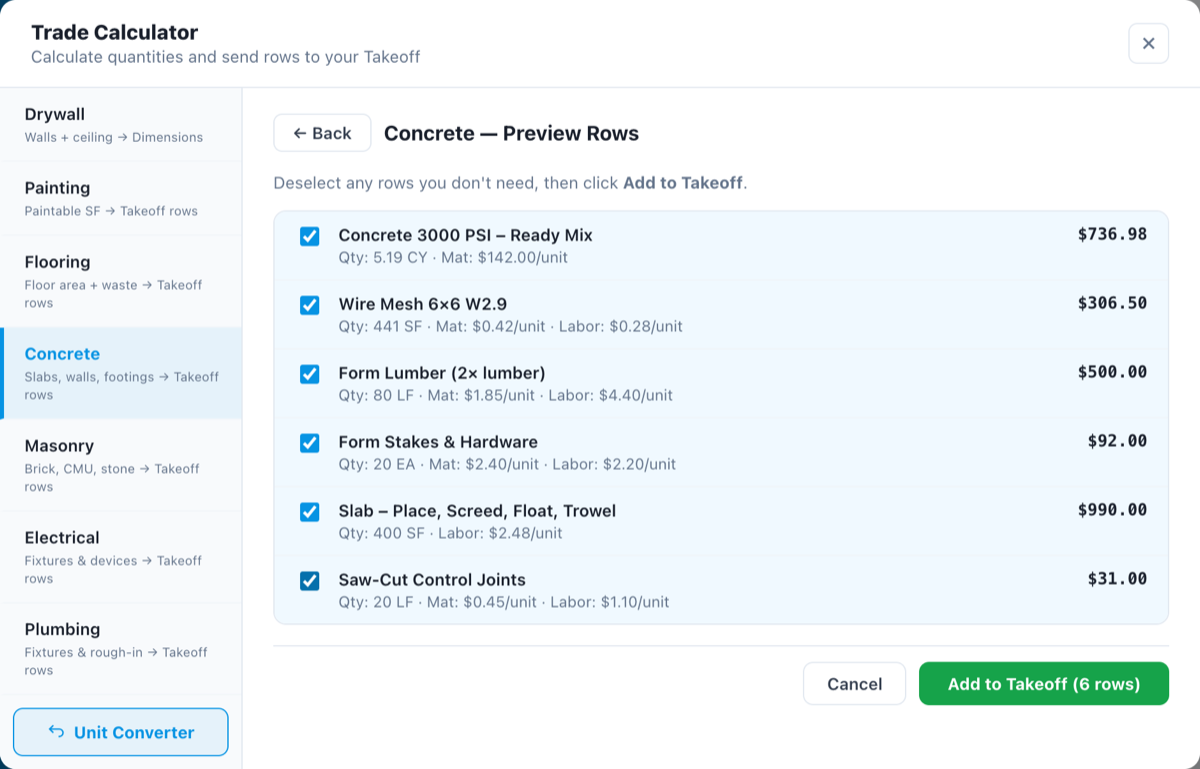
The concrete calculator turns a 20 × 20 ft, 4-inch patio slab into concrete, mesh, forms and finishing lines. Sample numbers.
Questions concrete contractors ask
How do I calculate cubic yards of concrete?
Multiply length by width by thickness, all in feet, then divide by 27. Add extra for uneven grade and spillage; many contractors add about 5–10%.
Can I estimate walls and footings too?
Yes. Quick Measure for concrete handles slabs, walls and footings and turns your measurements into estimate lines.
Does it work with QuickBooks?
Trades HQ exports your invoices in a format ready to import into QuickBooks, so your bookkeeper doesn’t have to retype them.
Is there a free trial?
Yes. Every plan starts with a 14-day free trial, and you don’t need a credit card to start. Plans start at $75 a month, and you can cancel anytime.
Examples on this page use illustrative numbers only. Use your own costs, rates and local requirements. This page is general information, not legal, tax, or financial advice.