Insulation Estimating & Invoicing Software for Insulation Contractors
Insulation bids come down to area, R-value and the coverage on the bag or kit. Trades HQ helps you price it with your own rates and shows whether each job made money.
R-value drives the material. A higher R-value means more depth, more bags or thicker batts.
Coverage varies by product. Every bag, roll and kit has its own coverage chart.
Access and prep. Tight attics, air sealing and baffles add labor.
Different methods. Batts, blown-in and spray foam price very differently.
How Trades HQ helps insulation contractors
Ready-made insulation items in your Price Book, like R-13, R-19, R-30 and R-38 fiberglass batts, mineral wool, blown fiberglass and cellulose, open and closed cell spray foam kits, and rigid board. Add your prices once and reuse them.
Labor-rate guidance by state. See typical insulation worker wages in your state, then set your own rate.
Measure from blueprints. Measure wall and attic areas right off a blueprint PDF.
Proposals customers approve online, then one click to invoice.
Progress billing for new-construction jobs.
Live job profit as labor and materials come in.
A blown-in attic estimate, step by step
Measure the attic floor area.
Pick the target R-value.
Use the bag's coverage chart to find the square feet per bag at that R-value.
Divide the area by that coverage to get the number of bags.
Add air sealing, baffles and labor.
Apply your overhead and profit.
Example (illustrative): a 1,200 sq ft attic, using a bag chart that lists 40 sq ft per bag at the target R-value.
Step
Math
Result
Attic area
30 × 40
1,200 sq ft
Bags from the chart
1,200 ÷ 40
30 bags
Baffles at the eaves
Count the rafter bays
Your count
Coverage changes a lot by product and R-value, so always use the chart for the bag you're installing.
Pricing tip: Price air sealing as its own line, so customers see the value and you get paid for the time. And remember that markup and margin aren't the same number: a 20% margin needs a 25% markup. The Estimating Basics guide walks through the math, and the free markup and margin calculator does it for you.
See it in Trades HQ
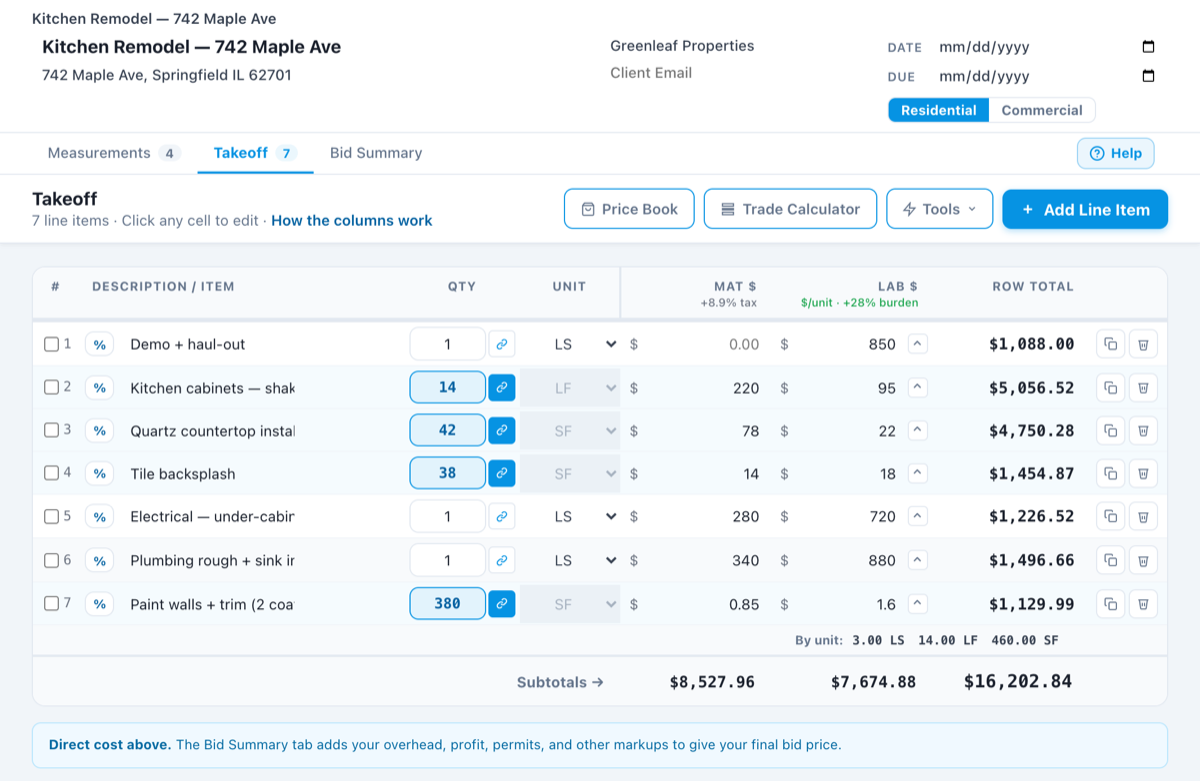
A sample estimate in Trades HQ. Each line has its own material and labor cost, and the Bid Summary adds your overhead and profit. Sample numbers.
Questions insulation contractors ask
How many bags of blown insulation do I need?
Find the coverage per bag for your target R-value on the bag’s chart, then divide your attic area by that coverage. Coverage varies a lot by product, so use the chart for the bag you’re installing.
Can I bill a new-construction job in stages?
Yes. Trades HQ supports deposits and progress billing on the same job.
Does it work with QuickBooks?
Trades HQ exports your invoices in a format ready to import into QuickBooks, so your bookkeeper doesn’t have to retype them.
Is there a free trial?
Yes. Every plan starts with a 14-day free trial, and you don’t need a credit card to start. Plans start at $75 a month, and you can cancel anytime.
Examples on this page use illustrative numbers only. Use your own costs, rates and local requirements. This page is general information, not legal, tax, or financial advice.