Why appliance installs are hard to price
- Every kitchen is different. Old shutoffs, short cords and odd cutouts change the job.
- Parts are easy to forget. Supply lines, power cords, vent kits and anti-tip brackets add up.
- Haul-away. Removing and disposing of the old appliance takes time and sometimes a fee.
- Gas and electrical work. Some connections need a licensed plumber or electrician, or a permit.
How Trades HQ helps appliance installers
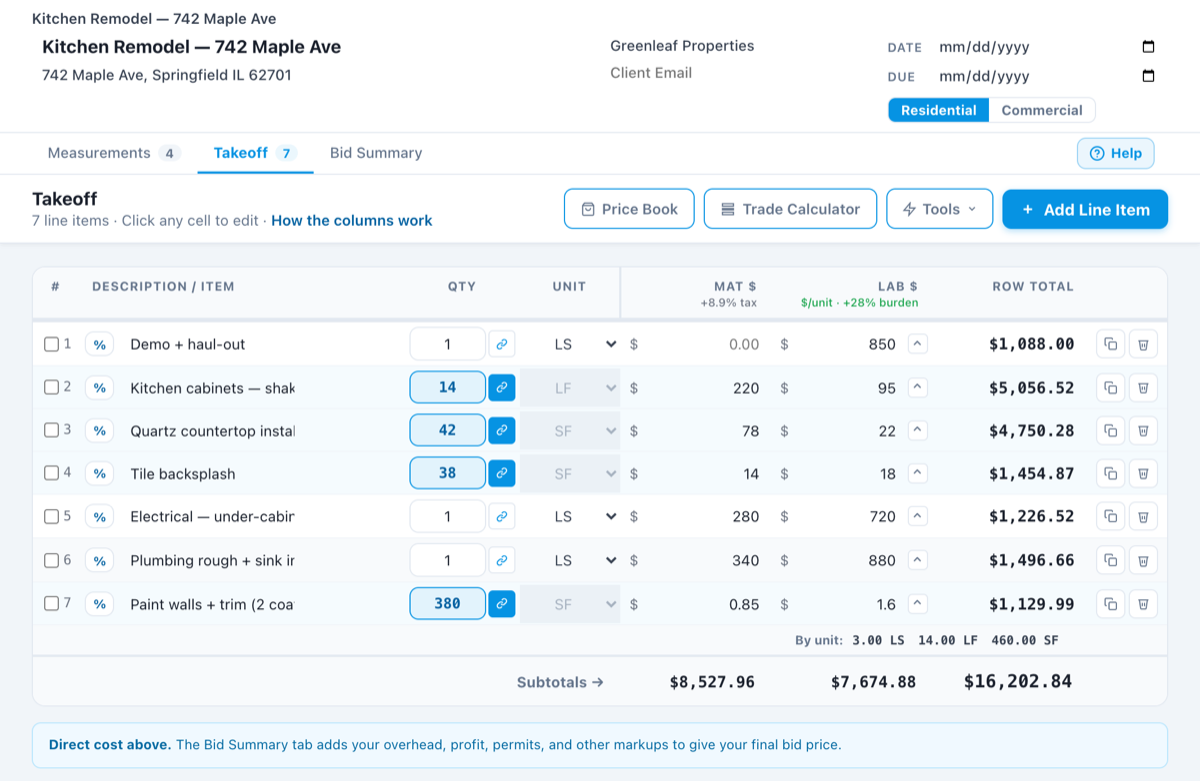
- Ready-made appliance items in your Price Book, like dishwasher, range, over-range microwave, hood, washer, dryer and disposal installs, plus supply lines. Set your own flat rates once and reuse them.
- Quick quotes from your phone, so you can price the job before you leave the house.
- Add-ons as their own lines, like a new shutoff, a cord or haul-away.
- Bid work out to other subs, for example a licensed plumber for a gas line.
- Proposals customers approve online, then one click to invoice.
- Live job profit across all your installs.
An appliance install quote, step by step
- Confirm the model, the space and the connections.
- Start with your flat install rate for that appliance.
- Add the parts it needs: supply line, cord, vent kit or brackets.
- Add removal and haul-away of the old unit.
- Add any trade work, like gas or a new circuit, from a licensed pro.
- Apply your overhead and profit.
Example checklist for a dishwasher swap (no prices; use your own):
| Line | Notes |
|---|---|
| Dishwasher install | Your flat rate |
| Braided supply line | Replace the old one |
| Power cord or hardwire kit | Match what's there |
| Drain hose connection | Air gap or high loop, per local code |
| Remove and haul away old unit | |
| New shutoff valve | Add-on if the old one is bad |
Gas and electrical connections may need a licensed pro or a permit where you work, so check your local rules.
Pricing tip: Keep a short list of priced add-ons, like shutoffs and cords, so the surprises are already on the menu. And remember that markup and margin aren't the same number: a 20% margin needs a 25% markup. The Estimating Basics guide walks through the math, and the free markup and margin calculator does it for you.